
This post may contain affiliate links. Please read our disclosure policy.
Learn how to make apricot jam to take full advantage of apricot season. My small batch recipe uses just three simple ingredients and no pectin to make a bright, tangy, deeply fruity jam that tastes like pure summer. Spoon it over labneh on toast, dollop it on homemade yogurt, or use it to top an apricot jam tart. It’s outrageously good every way.
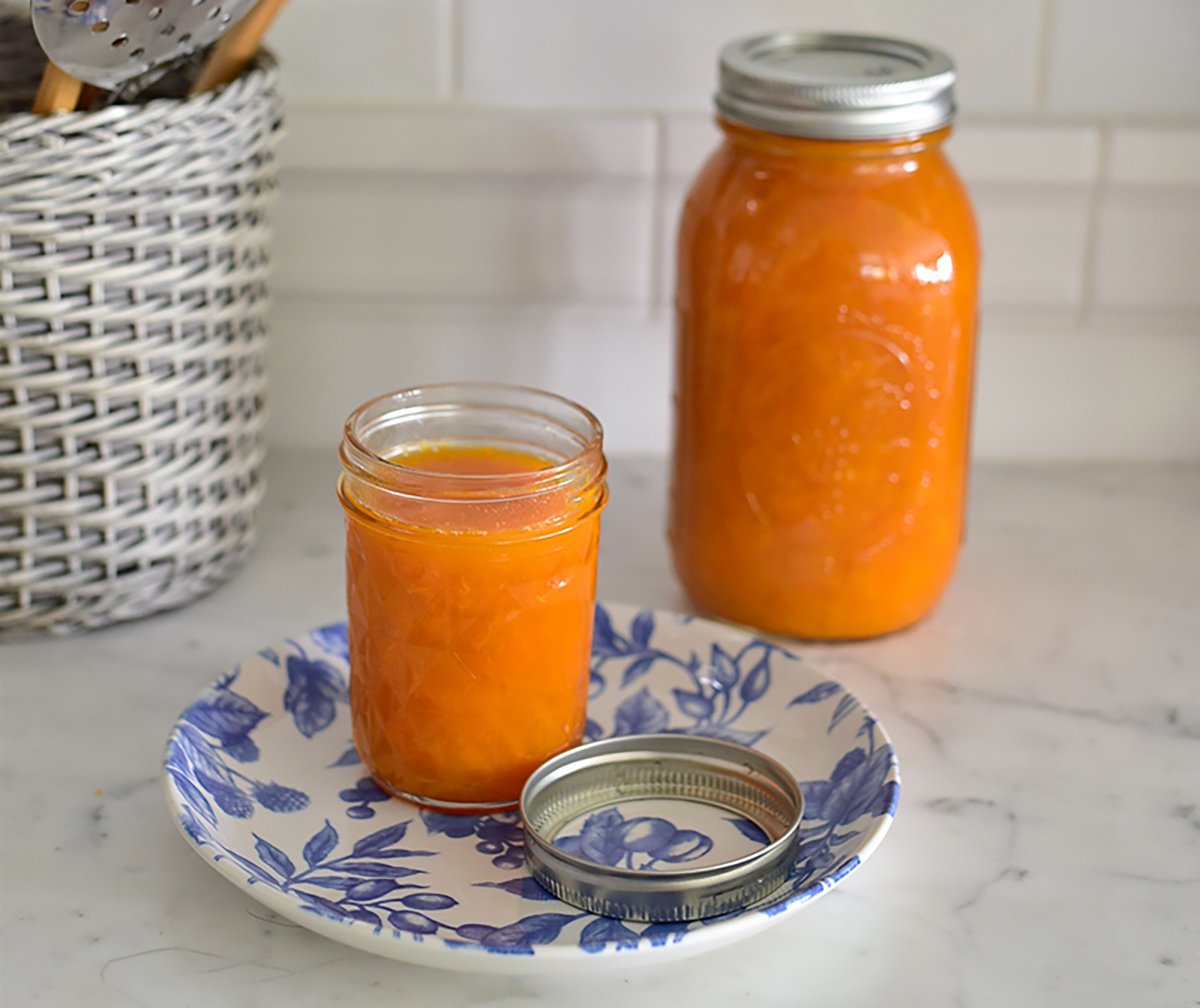
Ohh Apricot Jam! Ohh, anything apricot! The Lebanese are a fruit-obsessed people, with apricots ranking at the top of the class. Luckily, we can get beautiful, fresh apricots up north in Michigan (our season is late summer, not early summer), which we always, always transform into jam, among other delights, like my apricot chicken and apricot upside-down cake. I get this from my mother, who grew up making apricot jam with her own mother, and then with me. It’s a significant Lebanese culinary practice, mouneh, preserving a season’s harvest with care.
Making homemade apricot jam is not at all difficult; it just takes some time and patience. The process does require a heaping portion of…you. An hour’s worth of your hand stirring to prevent scorching and your patience waiting for the fruit and sugar to cook properly.
Take this as an opportunity to chew on some daydreams you’ve been wanting to have. A mind needs time to wander, don’t you think? Or you can hoist yourself up on the counter and sit there listening to your mother while she stirs the pot, as I did.
Ingredients and Notes
Please be sure to scroll down to the recipe card for the complete ingredient list and instructions!
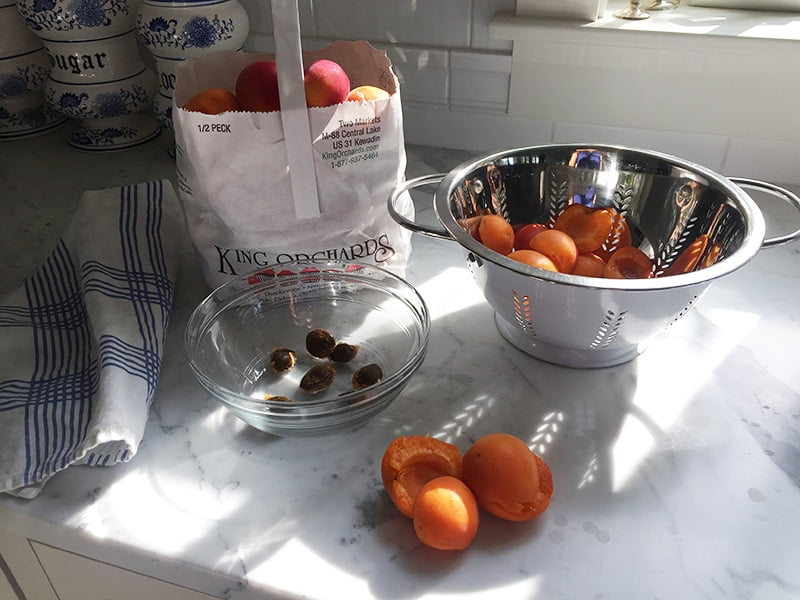
- Fresh Apricots: The star of this jam. Choose apricots that are slightly soft to the touch but still hold their shape. They should be ripe enough to split by hand and fragrant enough to smell like summer. You don’t need to peel them; the skins break down during cooking, add texture, and carry their own natural pectin. If fresh apricots are out of season, frozen apricots can work in a pinch. Avoid canned apricots. The flavor profile is entirely different, and the results are disappointing.
- Sugar: It takes a good amount of sugar to transform fruit into a spreadable jam. The sugar doesn’t just sweeten; it interacts with the natural pectin in the fruit to create the set and acts as a preservative. White cane sugar is my first choice because it lets that gorgeous orange color shine. Brown sugar works, but darkens the jam and mutes the brightness.
- Lemon: Fresh-squeezed lemon juice does double duty here. It brightens the flavor and provides natural pectin to help the jam thicken without any added pectin. I love lime juice with apricots just as much. Feel free to swap it in for a slightly different character. Either way, fresh is far better than bottled.
How to Make Apricot Jam
Before you begin: Set a small plate in the freezer. You’ll use it for the cold plate test later to check your set.
- Pit the apricots. Split ripe apricots open with your thumbs and pop out the pit. If they’re not quite soft enough, run a sharp knife around the pit and pull the halves apart. No need to chop! The pieces will break down as they cook. If the stem end of the fruit has a rough brown area, go ahead and trim that away. This doesn’t break down very well during cooking. I find it’s worth the time to trim.
- Combine ingredients. In a large, heavy-bottomed saucepan, combine the apricots, sugar, water, and lemon juice. Stir well to coat the fruit in the sugar. If you have time, let the mixture sit for 15-30 minutes to macerate. This draws out the juice and gives you a head start on flavor before the heat even comes on.
- Cook over medium heat, stirring occasionally, until the sugar dissolves and the mixture begins to simmer. The fruit will soften and begin to break apart.
- Reduce the heat and simmer, stirring frequently with a wooden spoon, for about 30 minutes. The apricots will collapse into a jammy mixture. Keep stirring. This is the time you’re giving the pot. Don’t walk away; a scorched bottom happens fast and is heartbreaking. Trust me.
- Continue to simmer another 20-30 minutes, stirring more frequently as the jam thickens. You’ll notice the bubbles slowing and the mixture pulling away from the sides of the pan.
- Check for doneness. Drop a small spoonful onto your cold plate and push it with your finger. If it wrinkles and holds its shape rather than running, the jam is set. You can also use an instant-read thermometer. The jam is ready when it reaches 220°F (104°C). Remember: it will thicken further as it cools, so don’t overcook it.
- Taste and adjust. Depending on how tart your apricots are, add a little more lemon juice for brightness or a touch more sugar for sweetness.
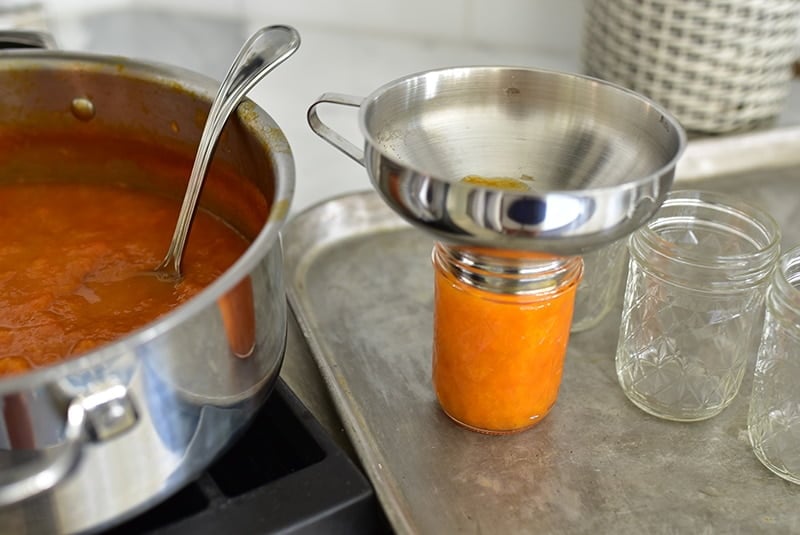
- Cool and jar. Off the heat, let the jam rest for 15 minutes, then ladle it into clean jars using a canning funnel. Seal and refrigerate.
Tips for the Best Apricot Jam
- Tending the pot: When preparing jam, maintaining medium-high heat helps to achieve the right consistency, but you have to stay nearby and keep stirring. This helps you take care not to scorch the bottom of the pot. If it’s your first time making jam, just be sure to keep a close eye on the pot as the mixture boils. Stir regularly to prevent sticking and monitor the texture frequently to avoid over-thickening. By boiling the mixture, the pectin in the apricots activates, ensuring it thickens properly without overcooking the fruit.
- Small batches: I’m a huge fan of small batches of jam. It makes the experience much more doable and approachable. A few jars to enjoy, and that’s a pleasure. Making less allows you to maintain better control over the cooking process. To make many jars for shelf-life storage, follow the canning instructions to sterilize and process the jam.
- Use a large pot: Utilize a large pot to allow plenty of room for the apricot mixture to boil vigorously without overflowing. A wide pot promotes faster evaporation of water, helping the jam to thicken more efficiently.
- Foam is normal: As the jam boils, a foam will form on the surface. Skim it off with a spoon before ladling it into jars for a cleaner-looking result.
How to Thicken Apricot Jam
Apricots are naturally lower in pectin than some other fruits, which is why this recipe cooks longer than a strawberry or raspberry jam. The combination of cooking time, natural fruit pectin, and lemon juice (a high-pectin ingredient) is enough to create a beautifully set jam without any store-bought pectin. Here’s what to know:
- The jam will look loose in the pot. This is normal. Hot jam is always thinner than cooled jam. Pull it off the heat when it passes the cold plate test or reaches 220°F, then trust it to firm up as it comes to room temperature.
- If your cooled jam is still too runny, pour it back into the pot, bring it back to a simmer, and cook for another 10-15 minutes. Check again with the cold plate test before jarring.
- For a thicker set, you can add a half teaspoon of pectin powder during the last few minutes of cooking, or stir in a tablespoon of finely grated apple, a naturally high-pectin fruit whose flavor disappears into the apricot.
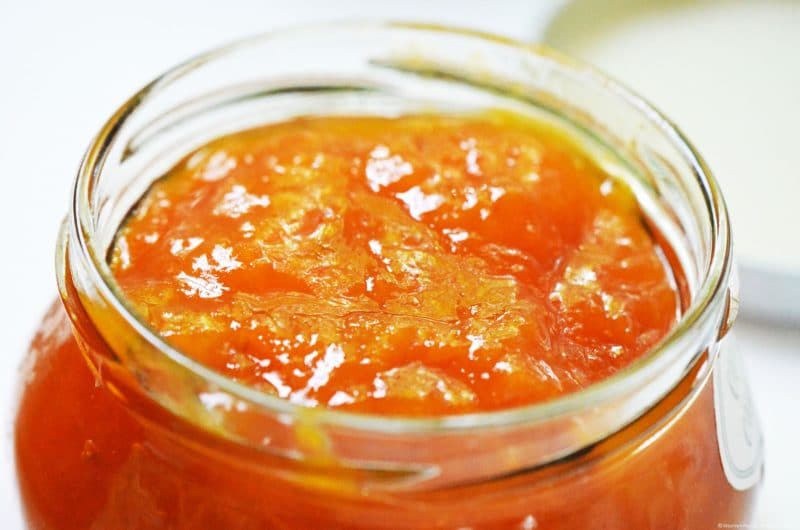
Ways to Use Apricot Jam
Every person in our family has been caught eating a spoonful straight from the jar, and I won’t pretend I haven’t. But when you’re ready to actually put it on something:
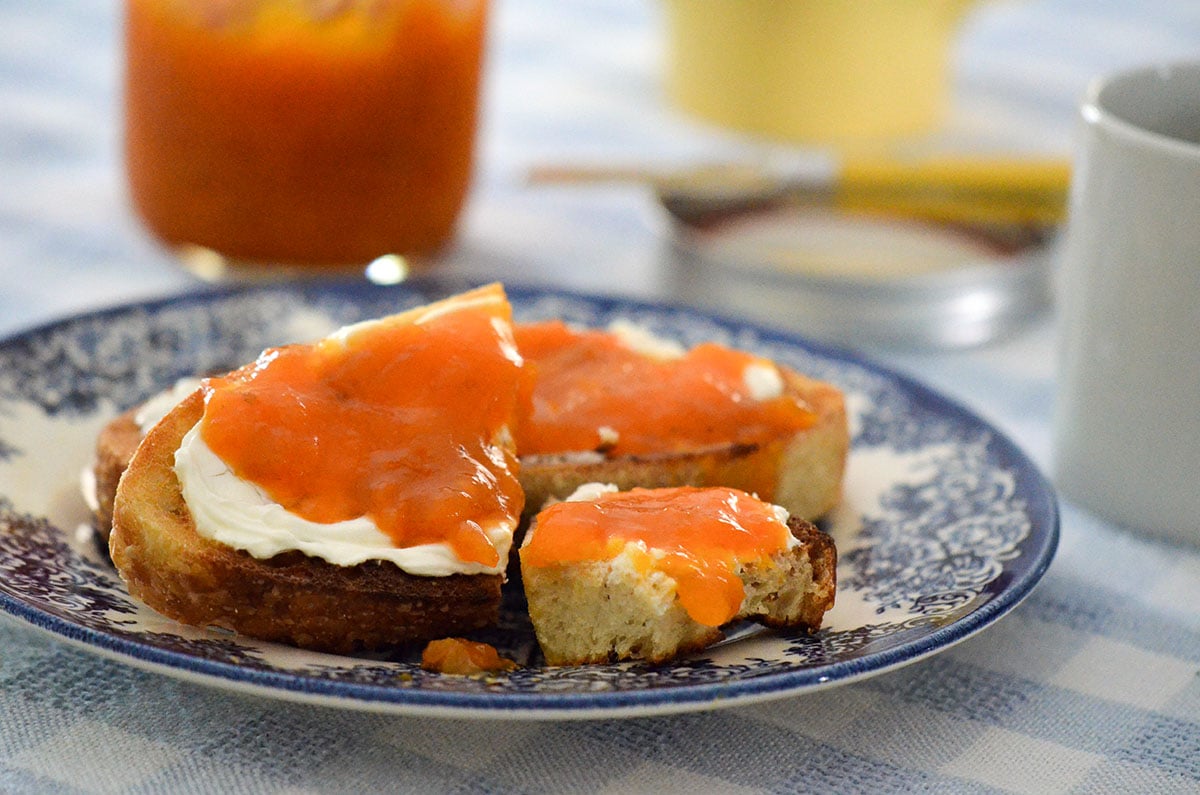
- Spread on pita bread or good toast with a generous layer of labneh underneath.
- Dolloped onto plain homemade yogurt or cottage cheese for a quick breakfast.
- Spooned over vanilla ice cream or panna cotta.
- Used as a filling or glaze in an apricot jam tart.
- Stirred into a vinaigrette for a fruit-forward salad dressing.
- Brushed over roasted chicken in the last 10 minutes of cooking as a sweet-tart glaze.
- Gifted in jam jars with a ribbon. It’s one of the most personal edible gifts you can give and is perfect for everything from holidays to hosting gifts.
How to Store
- Refrigerator: Ladle jam into clean, airtight jars immediately while it’s still hot. Let it cool to room temperature, then seal and refrigerate. Homemade apricot jam keeps for at least 2 months, though I’ve had a jar last a full year in the back of the refrigerator.
- Freezer: Ladle the jam into freezer-safe glass jars or lidded plastic containers, leaving an inch of headspace. It will keep for at least 6 months. Thaw overnight in the refrigerator before using.
- Water bath canning (pantry shelf life): Ladle hot jam into sterilized jars, leaving ½ inch of headspace. Seal with sterilized lids. Lower the jars into a pot of gently boiling water, covering the jars by at least an inch, and process for 10 minutes. Turn off the heat and let the jars sit in the water for 5 more minutes before removing. Cool to room temperature. Lids should be flat. If they’re domed, refrigerate instead. Properly canned jars keep in a cool, dark place for up to one year. Refrigerate after opening.

Apricot Jam
Equipment
- 1 Large, Heavy Saucepan
Ingredients
- 2 pounds apricots
- 1 1/3 cups cane sugar, or granulated white sugar
- 1/4 cup water
- 1 Lemon, squeezed
Instructions
- Pit the apricots by splitting them between your thumbs and removing the pit. If they are not ripe enough to split by hand, run a sharp knife through the flesh around the pit, pull apart, and remove the pit.
- In a large heavy saucepan, add all of the ingredients. Cook over medium heat until the sugar has melted and the mixture begins to simmer.
- Reduce heat and simmer over low heat, stirring frequently with a wooden spoon until the apricots are very soft and falling apart, about 1⁄2 hour.
- Reduce heat and simmer over low heat again, stirring frequently until the mixture thickens and the apricots have softened but some pieces still remain, another 1⁄2 hour.
- Taste. Depending on how tart the preserves are, and how tart you like it, add more lemon juice or more sugar.
- Off the heat, allow the jam cool for 15 minutes, then ladle into clean jars fitted with a canning funnel to prevent drips. Cover with the lids and refrigerate.
Notes
– Homemade apricot jam keeps for at least 2 months, though I’ve had a jar last a full year in the back of the refrigerator.
– Ladle the jam into freezer-safe glass jars or lidded plastic containers, leaving an inch of headspace. It will keep for at least 6 months. Thaw overnight in the refrigerator before using.
Nutrition
Nutrition information is automatically calculated, so should only be used as an approximation.















I just tried your recipe and it smells wonderful. I’m waiting for it to cool to taste.
I have a question for you. We had a lot of apricots and ‘life’ happened last year, so I had to put them in the freezer whole. This time I let them thaw, removed the seed then tried to squeeze as much of the pulp as I could off of the skin.
Do you think the skins would be ok to leave on even after they had been frozen (I have several more bags to do)? Thank you for any thoughts. We won’t get any this year, a late frost took care of all the fruit. maybe next year!
I keep the skins on for the preserves, so your frozen apricots ought to work great, with the pit removed! I’m jealous…
My sister-in-law makes this wonderful jam for us. And she saves the pits for my husband. He soaks them in water and cracks them open to extract the seed, which looks like a small almond. A very time consuming job. He fries the seeds in a little oil or butter until they’re slightly browned. Then he gives them to me. It’s a labor of love on his part. He grew up in Telkeif, a small farming village near Mosul, Iraq. They never wasted anything there!!!
Nothing makes me think of childhood more than apricot jam! All the women from my family made ot every summer, grandma, mom and now I make it for my family. We love it!
In Serbia we have a way to preserve preserves and it stays in the pantry for more than a year sometimes. You wash and dry the jars and lids, put them in the oven on 130 C to sterilize, and you pour hot jam into hot jars the minute it is over with the cooking. Then you put opened jars back in the oven for 15 minutes just to heat the top of the jam more. Then close with hot lids from the oven. Put all jars one by another, wrap them all in a blanket or big, chubbby towel and let it cool slowely for two days, untill it is at room temerature. And then it can stay on a shelf for a long, long time
I love your story and the pics
All the best,
Bojana
Beautiful, just beautiful! Thank you for sharing!
How much does this make? 2lbs of apricots seems like a lot more than I need…
Ann, this makes about 2 pints, which around here is gone fast!
how long will these preserves last in the fridge? and can they be frozen?
I’ve had them last as long as a year myself in the refrigerator, but a couple of months at least. I have not frozen the apricot jam but I suspect it would freeze just fine!
I found no mention of the skins. Do you remove them?
Nope! Just leave the the skin on for added flavor and texture.
My Great grandmother (Nana ) always made apricot preserves like this. And I just finished making them. The wonderful aroma of the apricots simmering brought back wonderful childhood memories. Thank you so much!
So special! I will be making apricot preserves again soon too!
I used to make apricot jam. 3 kilo apricots 3 kilo sugar? Not sure if that’s rights and 3 lemons for it to set. Actually I made jam out of every fruit except apples and pairs. I’d bought a new fridge but kept the old one and it was full of jams the wholeyyear round. I made grape jam that over set and when my parents came from England I made my dad finish it before he could try anything else. Poor daddy. Sorry. I must’ve bored you.
Judy I love your story! I’m sure yours is delicious; you use a little more sugar than I do, and more lemon too.
In South Africa we usually crack a few of the pips, blanch the nuts to remove the skin and add them at the end. Adds a lovely almonds flavour.
Maureen, I used your recipe when given too many apricots to eat from the tree of the “other grandma” of my grandsons. Absolutely delicious!! In fact, I think I’ll go make toast to put some on right now.
That’s great Elaine! I can’t wait for apricots up here…I’m ready for jam!
Maureen, if you sterilize the pots can the preserves be kept at room temperature?
Yes, sterilize the jars and they will have shelf life. Just be sure there is a seal on the lid (indicated by a popping sound when you open the jar).
Yum, looks amazing and really delicious. Do you know by any chance how to make “Amar El Din”. Arabic dried apricots rolls? Or the apricots pudding that is eaten cold? I moved for a year from Montreal (Canada) to the Dominican Republic and would love to make some. I am carving Lebanese food like crazy. 🙂
Thanks.
I love “Amardin” and have not made it, but looked into the method last summer. Maybe we’ll try it next year when the apricots are back–soooo delicous. I often buy amardin and I bet homemade would be excellent.
Okay–it is ridiculous how good this tastes!!! Mom and I just made it and she is thrilled with it!
I am so thrilled you made the apricot preserves!! I made another big batch this weekend, crazy delicious!
I love the interview with Mama Abood. She sounds as sweet as those apricots!
You know it!
Maureen!
I remember making these preserves with
Grandma one summer. Seems like I pitted a lot
more than 2 lbs of apricots. I recall a bottomless
bushel basket! Absolutely the best!
Love to you and Aunt Maryalice!
Rosemary
Wonderful memory Rosemary!! Thanks for sharing. I bet Grandma’s were so delicious, right from her own tree. xo–